

We gathered a group of seasoned online casino players from across the UK and requested them to put Total Casino through a rigorous side-by-side test https://totalscasino.eu/. One half of the day was spent using desktops; the other half was pure mobile, with smartphones clutched in hand during commutes and coffee breaks. The goal was straightforward: determine whether the desktop or mobile version of Total Casino delivers the best all-around gambling experience. Our testers evaluated everything from initial load times and menu logic to the captivating quality of live dealer tables and the convenience of withdrawing winnings. What appeared wasn’t a predictable landslide victory for either camp. Instead, a fascinating split developed, relying on specific tasks that each platform executed remarkably better than the other. Armed with a checklist of common player actions, we logged hours of real-money play to differentiate meaningful advantages from superficial quirks. Before you put your next bet, find out which device truly earns your screen time. This is what happened when we pushed Total Casino’s dual platforms to their limits.
Account Creation and Account Confirmation Pace
We tracked the complete sign-up journey from arrival page to confirmed account on each platforms. On mobile, the whole process averaged just four minutes and twelve seconds, with the camera-based document upload bypassing the need to switch devices. Desktop registration took closer to seven minutes because the verification required a separate email with attachment links, and our testers frequently had trouble with scanner apps. The mobile site also featured a one-tap “Auto-Fill Address” function that pulled UK postcode data from the device’s keyboard, a small luxury that gained precious seconds. No tester left the registration on any platform, but the mobile flow felt more modern and forgiving, especially for players joining during a lunch break. The desktop version, however, gave a more legible summary screen before final submission, which older testers appreciated for minimising errors. We noted that the SMS verification code was delivered immediately on each platforms, and the welcome bonus was credited within seconds regardless of device. Still, the mobile path claimed a clear victory in this category, showing that Total Casino has optimised its sign-up funnel for the smartphone generation without compromising desktop security.
Slot Performance and Graphical Display
We loaded a dozen popular slots, including “Gonzo’s Quest,” “Big Bass Bonanza,” and “Reactoonz,” on both platforms to assess visual fidelity and responsiveness. Desktop computers with dedicated graphics cards offered the smoothest animations, with particle effects and reel spins working at a buttery 60 frames per second. Mobile devices, even the iPhone 14, occasionally dropped frames during high-action bonus rounds when complex background animations kicked in. However, the mobile versions of these slots were not simply scaled-down ports; they included touch-optimised spin buttons and gesture controls that let players swipe to change bet levels, providing a layer of tactile engagement that desktop did not have. The immediate experience of pulling a virtual lever with a finger provided mobile play a visceral edge, especially in portrait mode. We also observed that mobile game loading times were marginally slower on 4G, averaging 4.1 seconds versus 2.4 seconds on a wired desktop connection. Still, the visual gap has shrunk dramatically over the past two years, and our testers evaluated the mobile graphics as “excellent” for smartphone standards. Finally, desktop won on sheer technical performance, but mobile stole the show for casual, fidget-friendly play that seems native to the device.
Customer Support Experience On Platforms
Our last task involved contacting live chat support to resolve a fake bonus query. The entry method varied: on desktop, a floating chat icon remained pinned to the corner of every page, whereas mobile tucked the live chat link inside a hamburger menu, needing two extra taps. Once linked, the chat interface on desktop was roomy, with a broad window that showed the agent’s responses and our message history without the necessity to scroll back constantly. On mobile, the chat window shared space with the keyboard, making the conversation to feel tight. The response time averaged 42 seconds on desktop and 47 seconds on mobile, a negligible difference. However, the mobile experience was enhanced by the capability to snap a screenshot of the issue and attach it directly from the phone’s gallery, a feature we used to accelerate the diagnosis. The support agent fixed our query on both platforms in under four minutes, and the tone stayed consistently professional. We concluded that while desktop offers a more comfortable environment for a long troubleshooting session, mobile’s mobile support is perfectly enough for quick fixes, especially when you can send visual evidence with a couple of taps.
Casino Game Browsing and Search Efficiency
Searching for a certain title like “Starburst” or “Monopoly Live” exposed clear contrasts in browsing approach. On desktop, the left-hand sidebar provided a comprehensive menu structure with filters for provider, variance, and feature purchase options, enabling users to drill down with a mouse. Our evaluators could browse 40 game icons at once because of the large layout, and the search field sat prominently in the top-right corner, providing auto-complete options as they typed. The mobile version, by contrast, used a footer menu with buttons for slots, live casino, and table games, plus a collapsible filter drawer. Browsing the mobile lobby was snappy, but the limited screen meant only eight game icons were visible at a time, requiring more swipes. The mobile search tool performed adequately, but the on-screen keyboard occupied half the screen, occasionally blocking the findings. Several testers remarked that the desktop feel felt like a curated library, whereas mobile felt like a neat mobile selection. To quantify the gap, we timed how long it took to search and start the game “Book of Dead.” Desktop scored 8.3 seconds, mobile 11.8 s. The desktop advantage became larger when selecting multiple options simultaneously, a task that became fiddly on a mobile screen.
Payment and Withdrawal Processing on Every Platform
We evaluated deposits and withdrawals using debit cards, PayPal, and bank transfers to assess platform efficiency. The deposit process was universally smooth, but mobile once more leveraged its native payment ecosystem. Apple Pay users on iPhone executed a £20 deposit in under three seconds via Face ID, while desktop users had to manually enter card details unless they had saved them in the browser. Withdrawal requests, however, introduced a divergence. The desktop site presented a full transaction history with expandable rows, simplifying to track pending cashouts and verify amounts at a glance. On mobile, the same information was present but required scrolling through a compact list, which felt less transparent. The actual withdrawal processing time was the same regardless of device, with PayPal withdrawals hitting our testers’ accounts in under six hours on average. We also remarked that the mobile site offered a dedicated “Withdraw” button in the bottom navigation bar, while desktop hid it inside a dropdown menu. This subtle design choice suggests that Total Casino expects mobile users to cash out more frequently. The verification for larger withdrawals, such as uploading a bank statement, was once more simpler on mobile due to the camera integration. Overall, mobile provided a speedier deposit-to-play pipeline, while desktop gave superior oversight for those who like to scrutinise every transaction.
Mobile-First Features: Touch-Based Controls and Speedy Play
Total Casino’s mobile version stands out when catering to the rhythm of modern life. We uncovered a suite of touch-centric features that desktop simply cannot replicate. The most acclaimed was the “Quick Spin” toggle, which allowed players to quicken reel stops with a double-tap, effectively reducing the duration of a 20-spin session. The mobile lobby also included a “Recently Played” carousel that responded to swipe gestures, making it effortless to go back into yesterday’s preferred slot. Portrait-mode play, available on most slots, let testers grip the phone with one hand and spin with a thumb while sipping a coffee with the other. During our commute simulation, the session timeout was increased slightly on mobile, recognising that players might lock their screen between stops. The deposit process on mobile further utilised the device’s capabilities, offering Apple Pay and Google Pay as one-touch options that bypassed card entry entirely. These integrations made funding a balance feel as frictionless as buying a song on iTunes. Our testers noted that these mobile-first enhancements converted what could have been a compromised experience into a truly distinct, even superior, way to play for short, spontaneous sessions.
Early Observations and Onboarding Flow
Launching Total Casino on a desktop right away gave our testers a sense of sprawling possibility. The large screen real estate let the full brand colour palette and high-resolution hero banners to pop, creating a casino floor atmosphere even from a home office in Birmingham. Registration, however, proved faster on mobile. The mobile site cleverly compresses the form fields into a single vertical scroll, with a tap-friendly numeric keypad for phone numbers and a quick biometric login option, reducing approximately 30 seconds off the registration time compared to desktop. Desktop users, meanwhile, faced a multi-step form spread across several pages, which felt slightly awkward on a 24-inch monitor. The mobile welcome flow also included ID verification via camera capture, capturing a passport photo in seconds, whereas desktop users had to manually upload scanned files. Once logged in, the desktop lobby presented a panoramic game grid that made browsing feel like window-shopping on Oxford Street, while mobile used a card-based layout that emphasised thumb reach. Both left a positive first impression, but testers unanimously agreed that mobile onboarding appeared built for speed, while desktop catered to explorers who want to take in the atmosphere before committing to a game.
Live Casino Experience: Desktop’s Big Screen Advantage
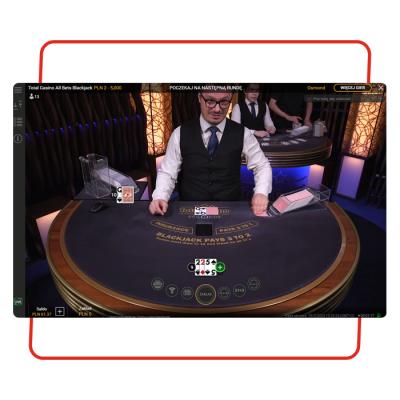
When we unveiled Total Casino’s live blackjack and roulette broadcasts, the desktop experience right away justified its larger footprint. The HD video feed covered the monitor, enabling us to see the dealer’s facial expressions and the texture of the felt without straining. A multi-camera view on desktop offered us the classic wide shot plus a close-up of the wheel or card shoe, and the chat window sat comfortably to the side without crowding the game. On mobile, the same stream was crisp and stable, but the interface obliged a choice between viewing the table clearly and using the betting grid. In landscape mode, the bet buttons overlapped the bottom portion of the video, and in portrait mode, the feed shrunk to a postage stamp above the chips. The chat feature on mobile was a cramped input process that few testers bothered to use. That said, mobile’s capacity to spin a live roulette wheel from a park bench in Edinburgh added a layer of novelty that no desktop could match. The audio quality through headphones was excellent on both platforms, but the sheer visual drama of a live game show like “Crazy Time” reached its peak on a 27-inch monitor. For committed live dealer games, desktop is the unrivaled champion.
Laying the Foundation for Our Two-Device Test
Our testing panel consisted of eight UK-based players, each with at least three years of online casino experience. We supplied identical Total Casino accounts loaded with a reasonable balance to ensure equity. The desktop setup used a variety of Windows PCs and Macs running Chrome and Safari, while mobile testing took place on both iOS and Android devices, primarily iPhone 14 and Samsung Galaxy S23 handsets. Crucially, we assessed on both Wi-Fi and mobile data networks, including those offered by EE and Vodafone, to simulate real-world conditions like a living room session or a train journey from Leeds to London. Each tester finished a structured series of tasks: registering, depositing, finding a specific slot, playing 20 spins, launching a live blackjack table, contacting support, and cashing out. We timed every action, noted friction points, and compiled subjective comfort ratings. We even simulated poor signal conditions by throttling bandwidth, because no UK player should expect perfect 5G everywhere from Cornwall to the Highlands. This systematic approach allowed us to pinpoint performance differences that casual users might overlook but that significantly influence long-term enjoyment.